
We’ve all been there once: pulling up to that cute little European city you’d been enamored with for months after saving it to your Instagram faves, only to realize the crowd-free, idyllic version exists only on social media.
Or at some ungodly hour that travel influencer you follow didn’t bother mentioning they were up at.
Germany’s full of those: from the jam-packed biergartens of Hamburg, down to Munich‘s gongshow of a Marienplatz, it feels less like your typical Old World escape, and more like a game of dodge-the-selfie-stick-army.
Lucky for the History buff that lives in you, not all German gems have met the same dire fate. In fact, the oldest city in the country, packed with 2nd-century Roman monuments and traditional bars serving up local craft beer from around $4, still feels relatively unspoiled:
Welcome To Trier: Germany’s Oldest City Dating Back To The 2nd-Century AD
Lying within easy reach of the Belgian border, and barely 10 miles from Luxembourg—Luxembourg City itself is around 30 miles away—Trier is the oldest German city on record.
We’re talking an often-overlooked, 113,000-people-strong, mid-size hub with over 2,000 years of fascinating history to its name, easily making it Germany’s most ancient major settlement, in line with Roman-era cities across Spain, France, and Italy itself.
From a once-powerful imperial capital of the Roman world, and the most important city on what is now German soil at one moment in time, to a secondary destination, arguably more famous among cross-border Luxembourger visitors than your average American:
Last year, Trier registered only 467,804 overnight visitors, according to the city itself, far behind Munich’s 6 million visitors in 2025.
Not that we’re complaining, mind you. We like our ancient gems without six-deep selfie queues.
Some Of The Best-Preserved Roman Buildings North Of The Alps
Not to go full History lecturer on you, but there’s no way you could fully grasp Trier’s significance and magnitude without dabbling a little into its glorious past.
It was founded around 16 BC as Augusta Treverorum, which is basically good old Latin for ‘Augusta among the Treveri’, and by the end of the 3rd century, it had been elevated to the status of one of the Roman Empire’s four imperial capitals under the Tetrarchy.
Granted, the empire had spent decades lurching from civil war to frontier crisis, Germanic incursions, and emperors dropping like flies, and Diocletian’s four-capital arrangement was essentially one gigantic administrative attempt to stop the whole thing folding in on itself.
Still, we’ll go out on a limb and say having been to an actual Roman imperial capital on German soil is a considerably better travel story than your basic-AF coworker Steve coming back from Rome with a Colosseum selfie and suddenly thinking he’s Mary Beard.
You can keep Rome, Steve.
UNESCO itself notes Trier became one of the Tetrarchy’s capitals at the end of the 3rd century and was once known as the ‘second Rome‘.
There’s no Ancient Colosseum here, sure, but there’s something equally cool in our book:
Behold: Porta Nigra
Trier’s Stunning Roman-Built, Gray-Sandstone Ancient Gate
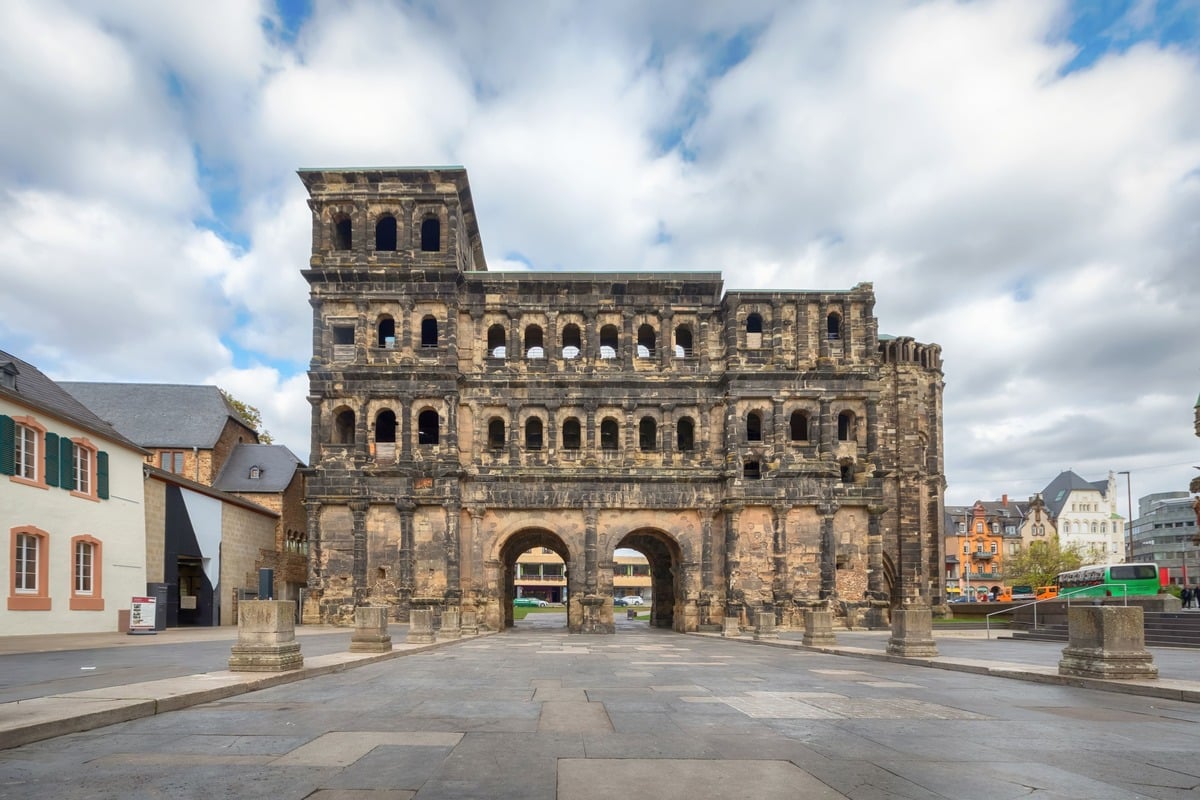
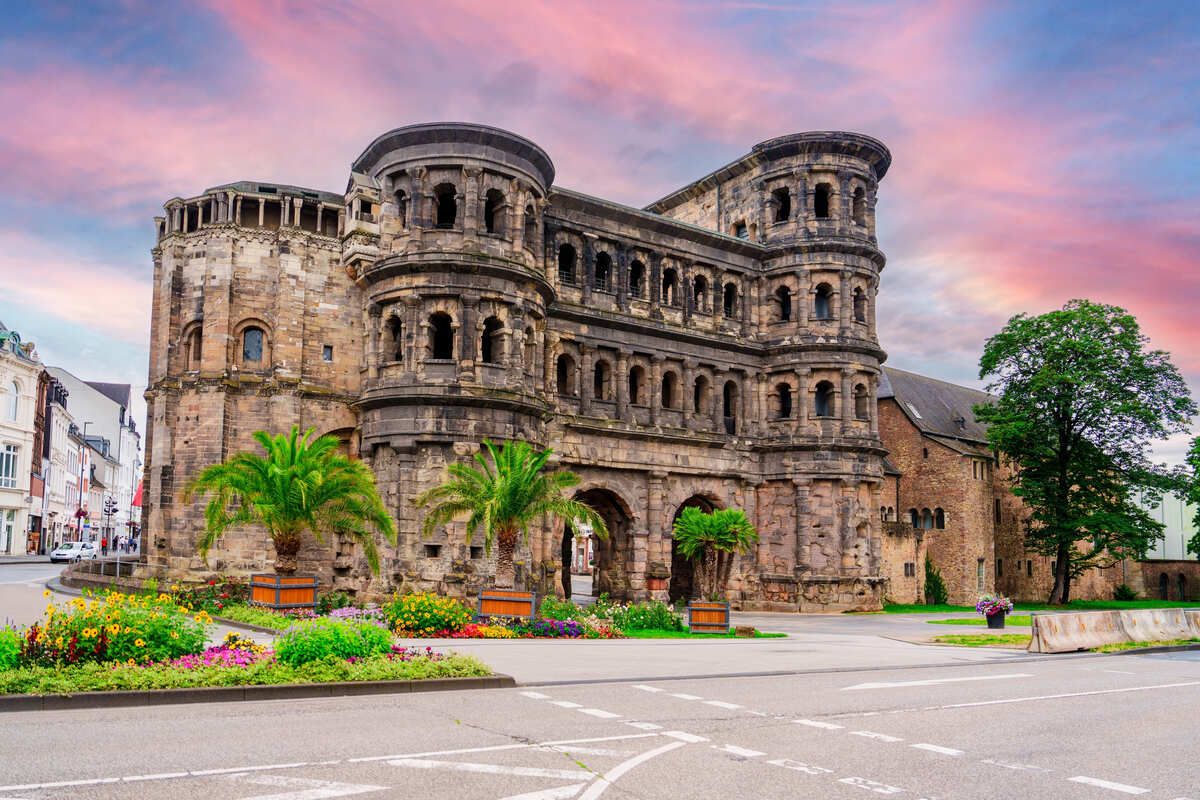
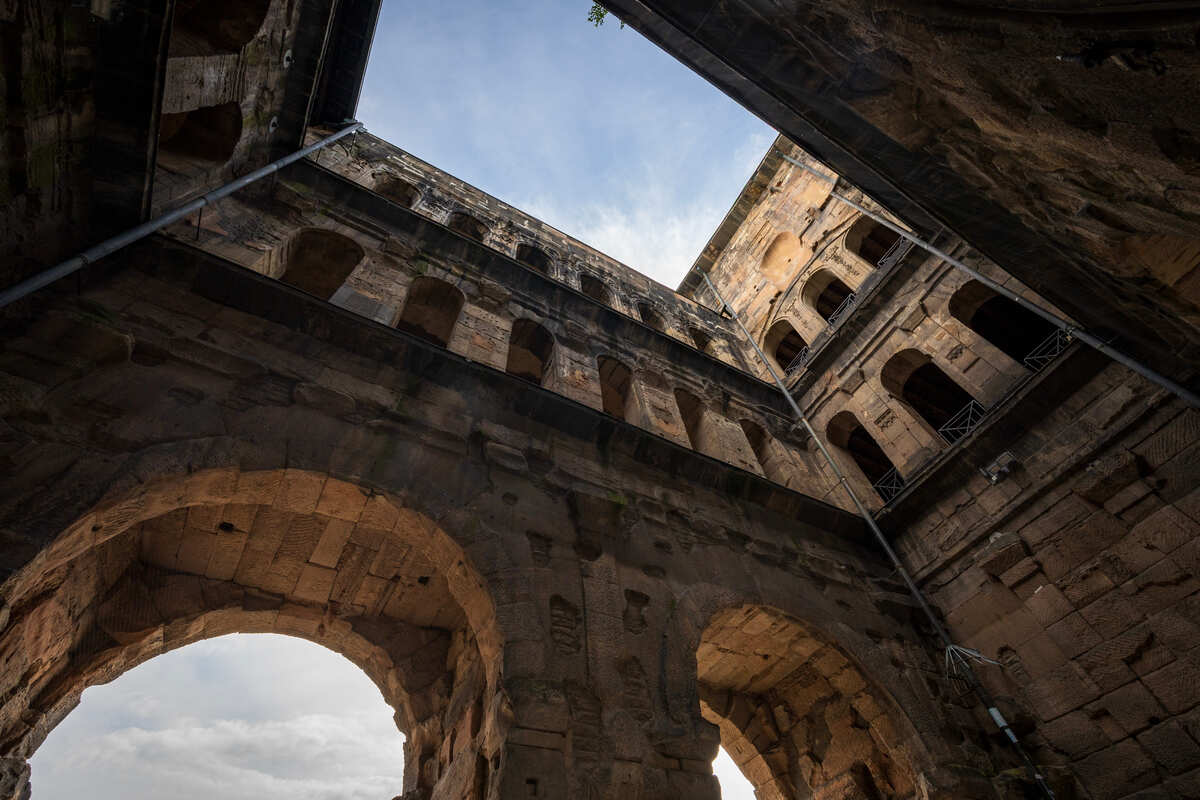
Porta Nigra, or Black Gate, is a massive, Roman-era gray sandstone beauty that’s been guarding the entrance to the Historic Center for close to two millennia.
You won’t find a better-preserved Roman city gate anywhere North of the Alps, certainly not in largely rebuilt, post-WWII Germany.
It’s no wonder it’s a UNESCO World Heritage Site. One of the O.G.-ish ones, too, inscribed all the way back in 1986.
You know, before it sometimes felt like UNESCO started handing the badge to any and all crumbling stone walls that successfully filled out some paperwork.
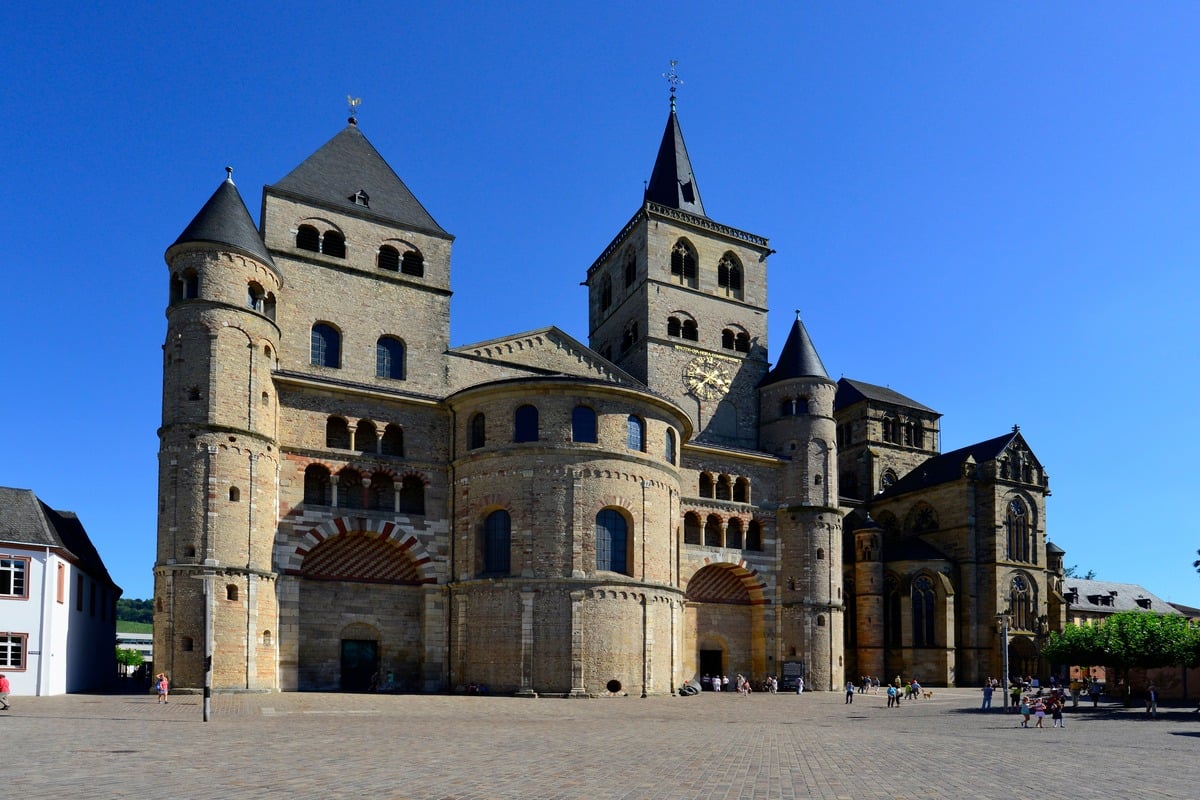
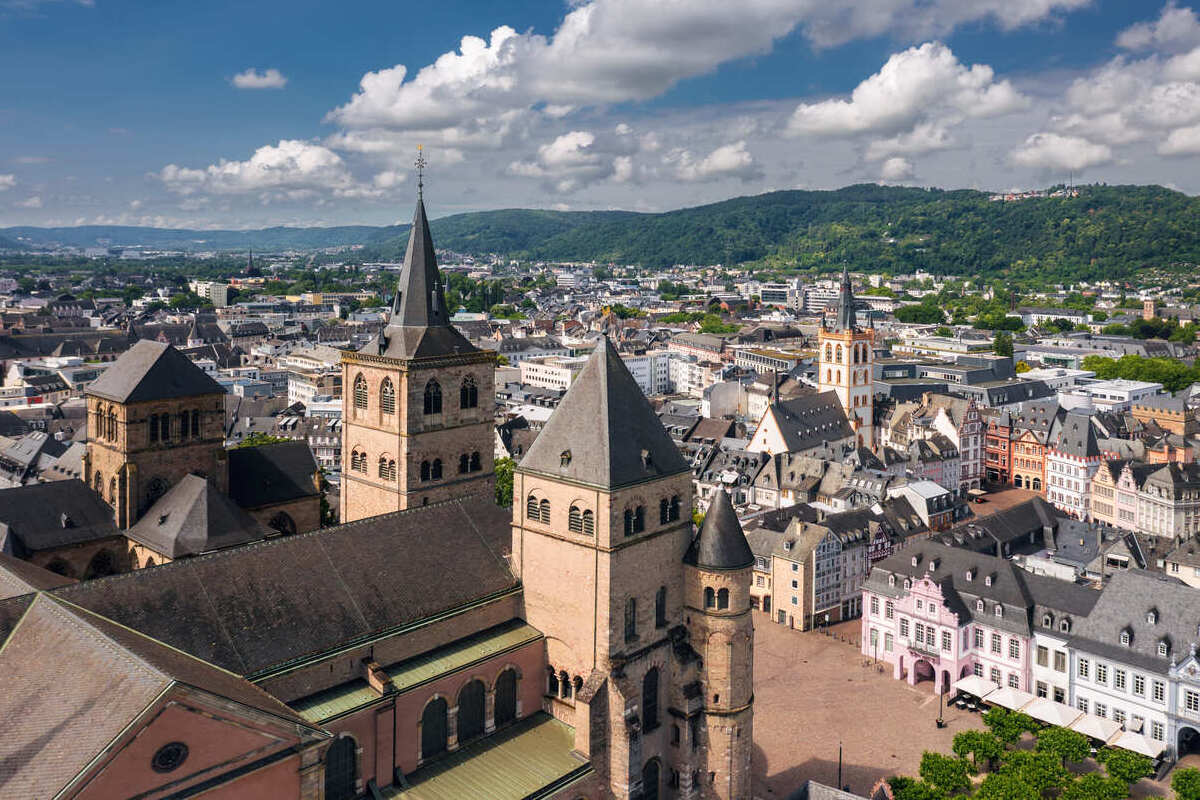
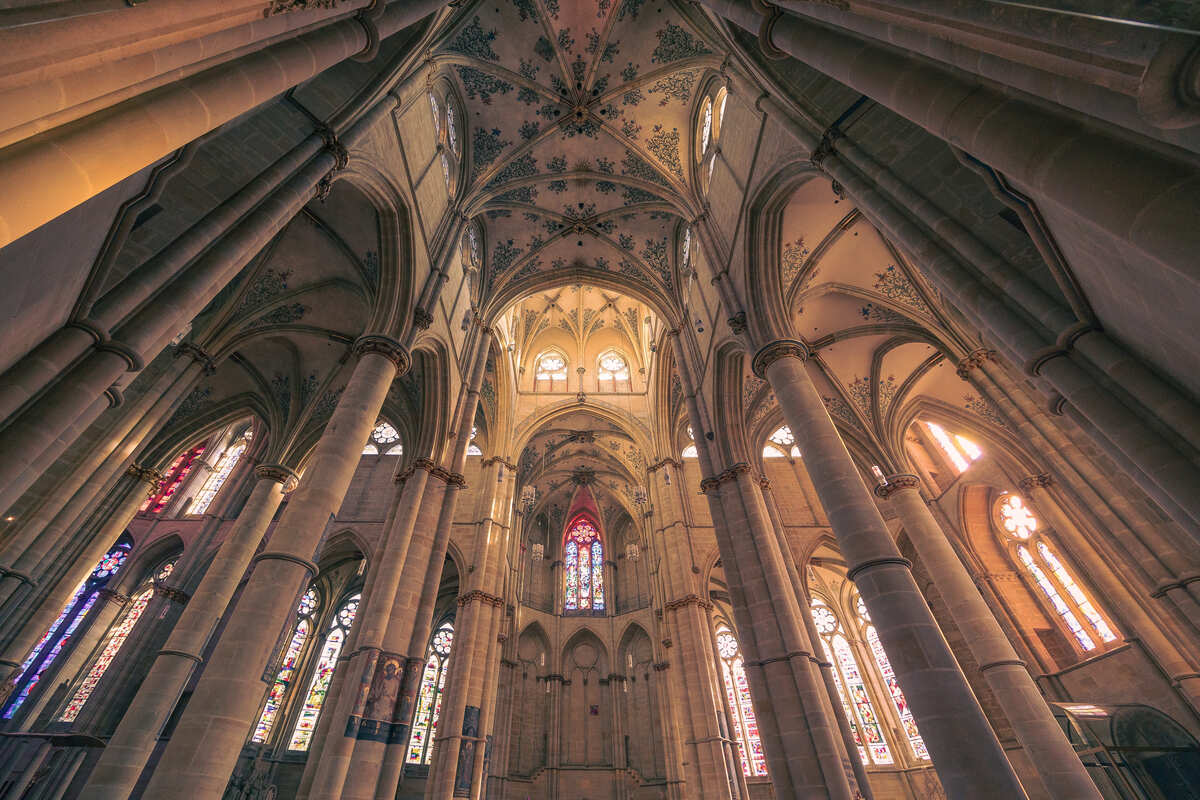
That’s not the only ancient structure you’ll find strolling around the compact Old Town’s cobbled lanes: Trier Cathedral is a monumental, four-tower edifice rising above red gable roofs and church spires.
Yet another UNESCO-listed gem—you’ll soon notice that’s a running thread across Trier—it is Germany’s oldest cathedral, built over a Constantinian palace complex that was converted into an enormous church beginning around the year 330.
Parts of the cathedral’s Roman fabric survive to this day, layered beneath centuries of Romanesque, Gothic, Baroque, and everything-in-between additions.
But wait, we’re not finished yet:
Ancient Monuments Galore
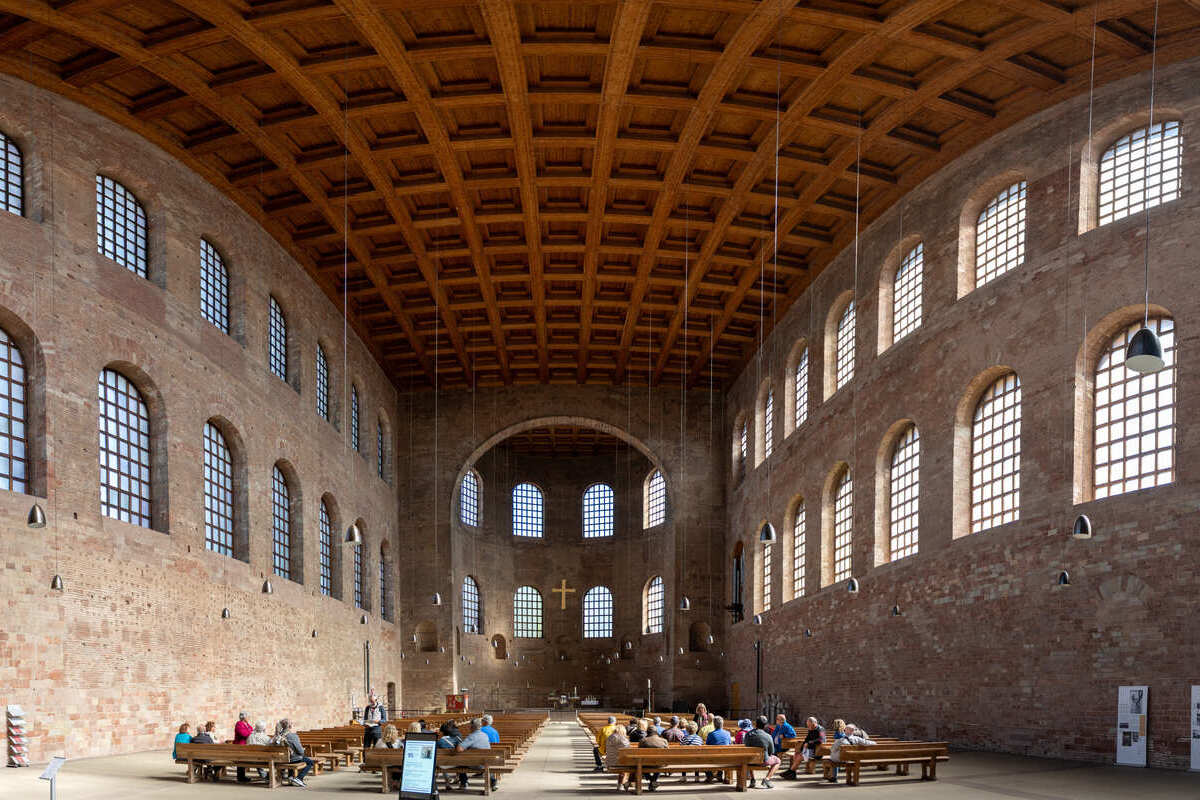
A short walk from the cathedral, Aula Palatina, otherwise known as the Constantine Basilica, is a grand, brick-built imperial audience hall dating back to the early 4th century.
At roughly 220 feet long internally, with walls rising over 100 feet, it remains one of the largest column-free rooms to survive from Antiquity. Looking at it from the outside, you’d swear the Romans packed up and retreated back to the Italian Peninsula yesterday.
Other must-see Roman remnants around Trier include:
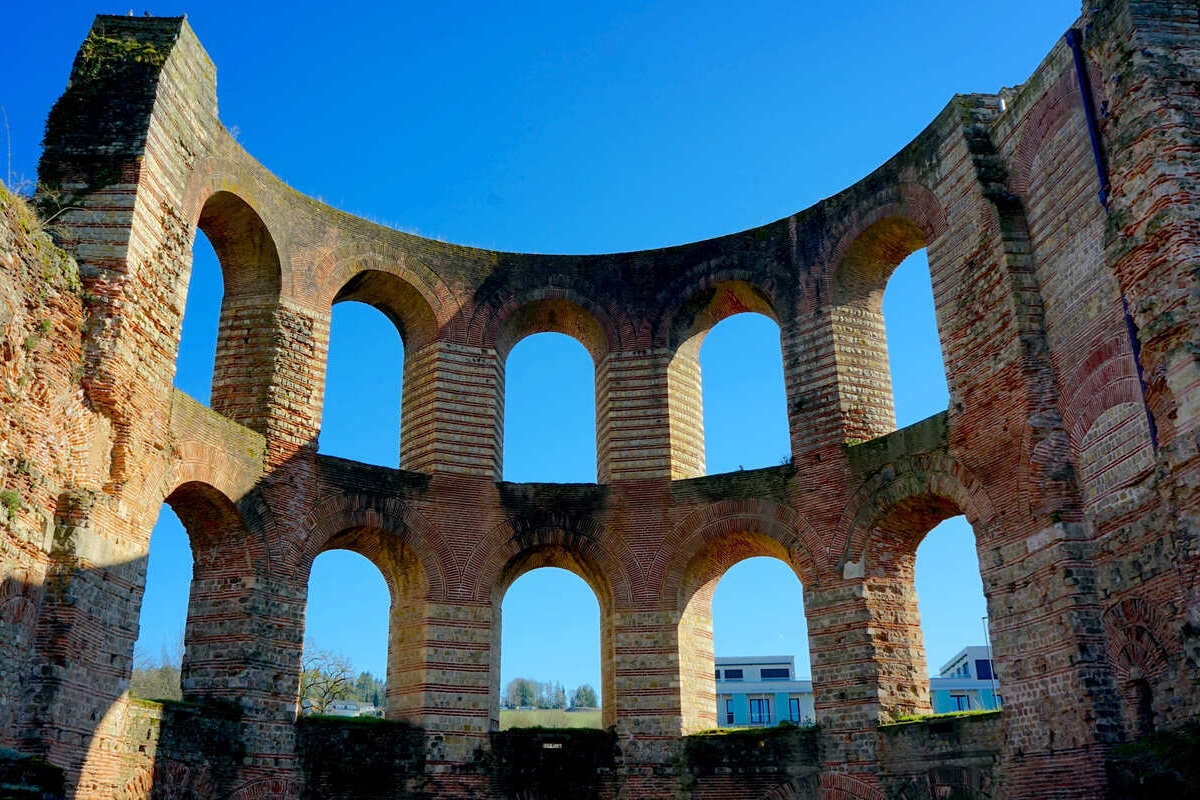
- The ruins of three separate Roman bath complexes, including the Barbara Baths, a sprawling 2nd-century facility covering roughly 452,000 square feet and generally regarded as the largest Roman baths north of the Alps
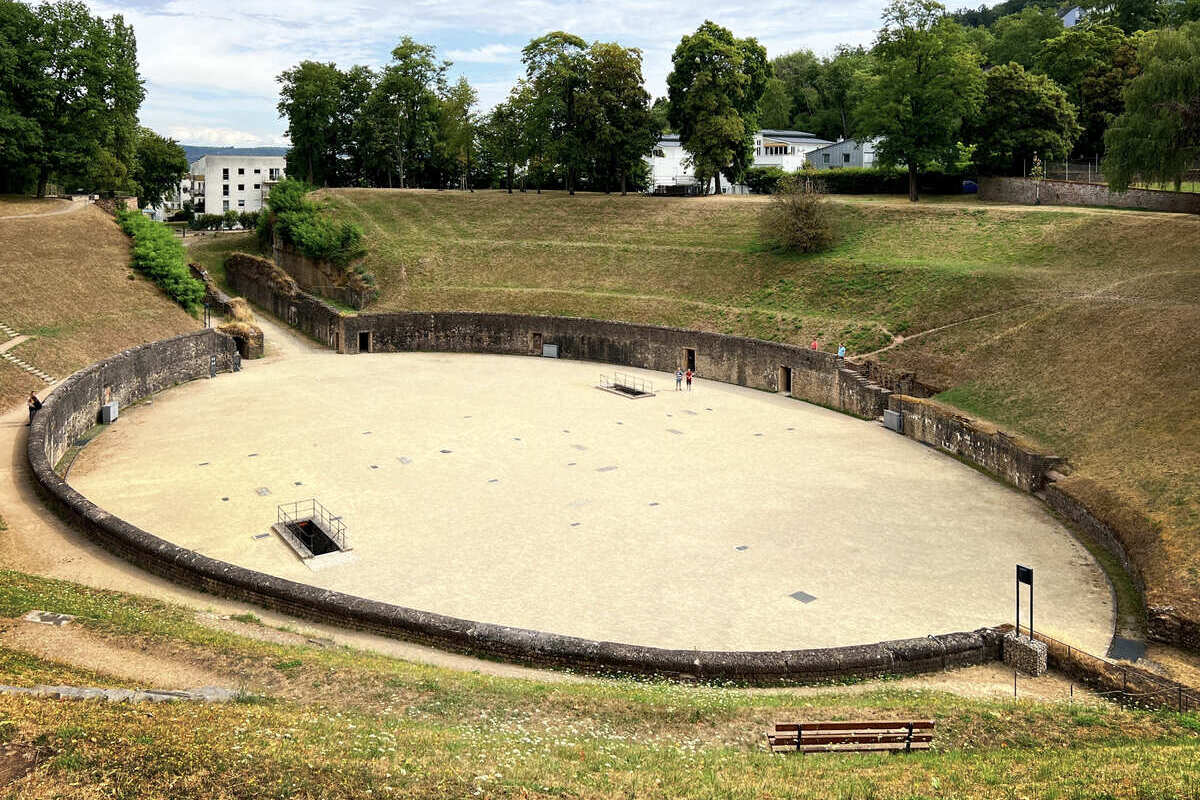
- The Trier Amphitheater, a 2nd-century Roman arena that once seated roughly 18,000 spectators at its peak
- The 2nd-century AD Roman Bridge, or Römerbrücke, spanning the Moselle River, whose Roman stone piers are still supporting the weight of modern traffic almost 1,900 years later
- The Thermen am Viehmarkt, a lesser-known Roman bath site sitting right beneath a modern glass pavilion—apparently you can’t so much as build parking in Trier without digging up Ancient Rome
Is Trier, Germany Safe To Visit?
Wondering how safe Germany is to visit right now?
The country remains at Level 2 on the U.S. Department of State’s official Travel Advisory. In plain, non-bureaucratic terms, this means Americans can visit while exercising ‘increased caution’.
The reason why?
Note From The Editor
Just one sec! If you enjoy reading great human-written articles, the best way to see a few more is to follow us on Google so we become one of your preferred websites. Thank you so much for reading. Now back to the story!
The advisory itself specifically cites terrorism, with U.S. authorities warning that lone actors and extremist groups remain a persistent threat in Germany and elsewhere in Europe.
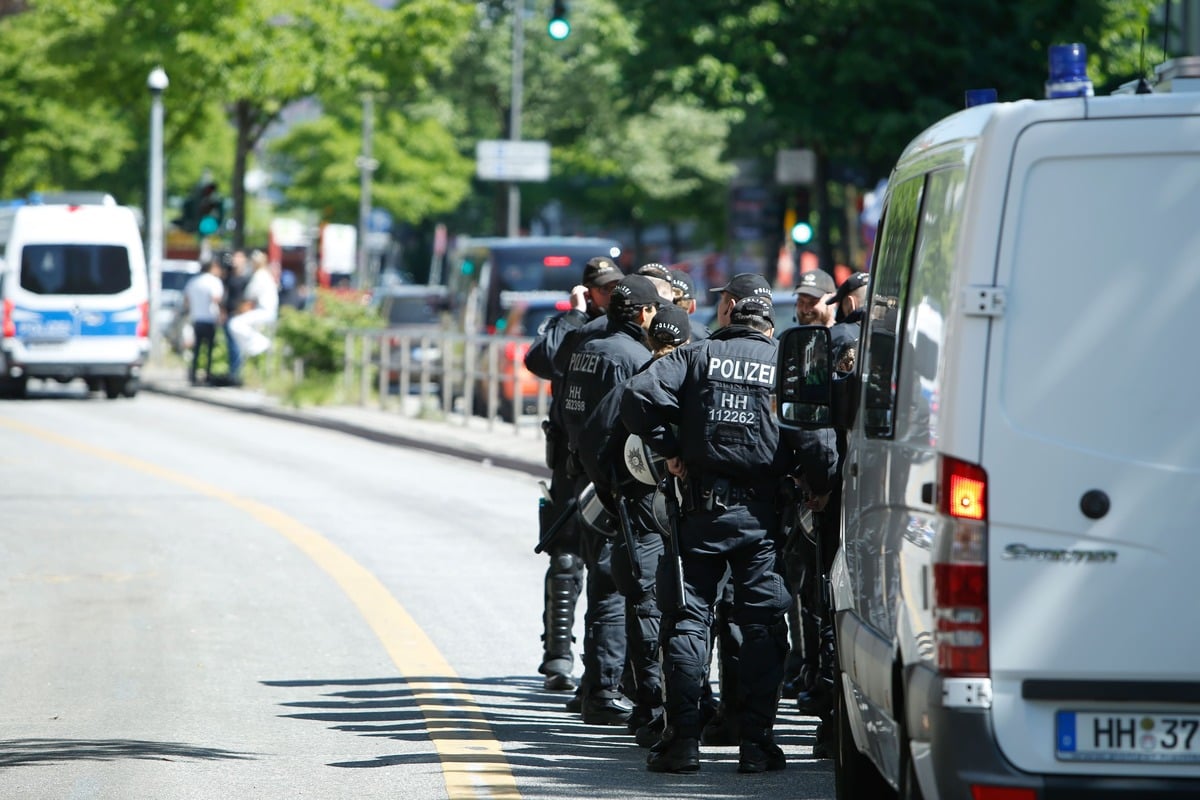
Separately, the Department notes that violent crime is rare overall, though it’s more prevalent in major cities, transport hubs, and large metro systems. And that’s an important distinction here, because Trier is way more chill and low-key than cities like Düsseldorf, Cologne, or Berlin.
On the Travel Off Path Traveler Safety Index, a score based on reports from recent visitors, the country earns a suboptimal 79 out of 100, due in part to the concerns already highlighted above.
The good news is, even when things get a little hairy in larger German hubs, cozy little Trier tends to feel worlds removed from it.
Numbeo currently gives Trier a Crime Index of just 29.2 and a Safety Index of 70.8, with perceived violent crime sitting at a remarkably low 19.7 out of 100.
Trier Beyond The Roman Layers
Of course, Trier’s not fully Roman in this day and age, especially after two full-fledged world wars.
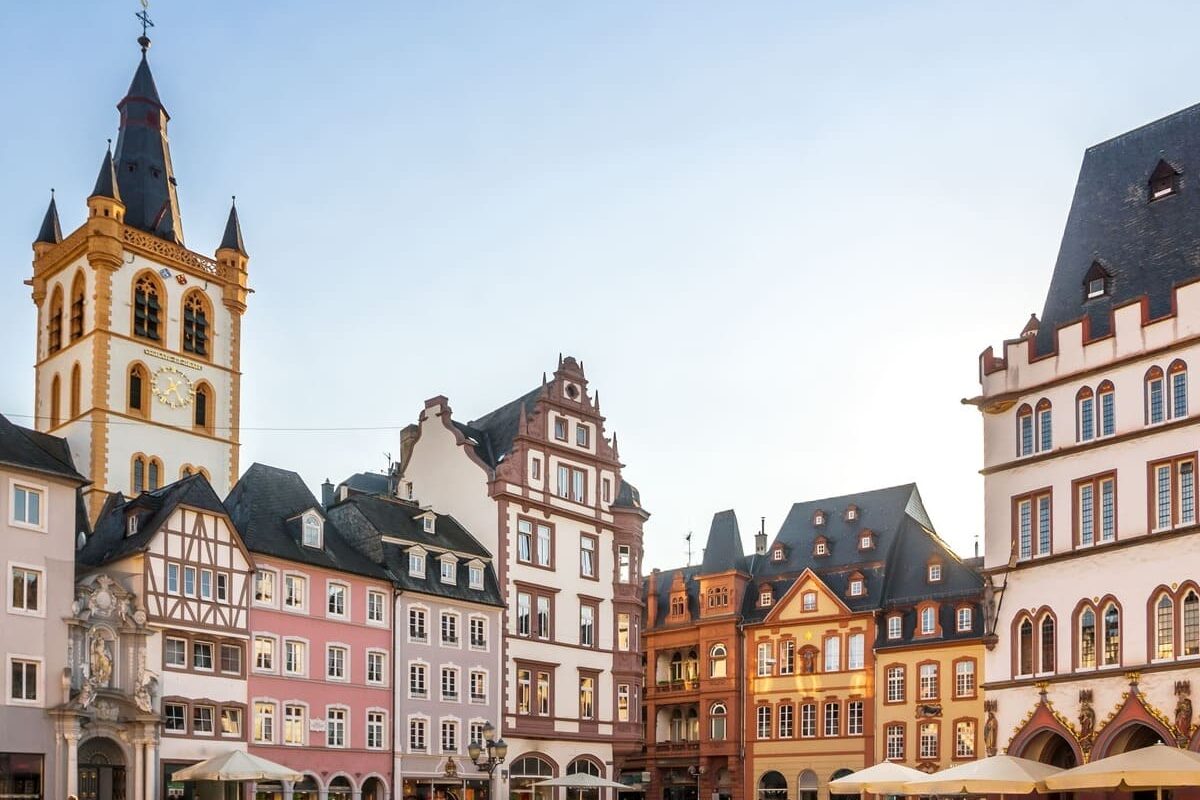
Add in timbered buildings hugging cobbled lanes, buses whooshing past weathered stone façades, and a lively Hauptmarkt flanked by colorful townhouses and coffee shops, and you get this weirdly seamless, unexpected mix of Ancient Rome and a thriving German town.
Outside the picture-perfect ancient center, you’ll find a vibrant student city peppered with low-key bars, Bohemian hangouts, and biergartens galore.
Head out toward Olewig and grab a table at Blesius Garten, home to Kraft Bräu, Trier’s first modern house brewery.
They make everything from Helles and Dunkel to Weizen and hoppier modern craft brews, and a half-liter Kraft Bräu Helles currently costs $7. If you’re only after a smaller 0.3-liter glass, that’s roughly $4.40.
You’d also be surprised by how relatively affordable eating out can be.
A full meal in an inexpensive restaurant in Trier averages around €15, or roughly $17–18, while a proper 3-course dinner at a mid-range place works out to around $46 per person.
The Birthplace Of Communism??
Trier’s appeal for the historically curious doesn’t stop at Roman ruins and $10 döner kebabs, either.
If you ever get cornered with ‘Where was Karl Marx born?‘ during a Friday-night pub quiz, now you know which answer to scream before Steve from Accounting steals your point.
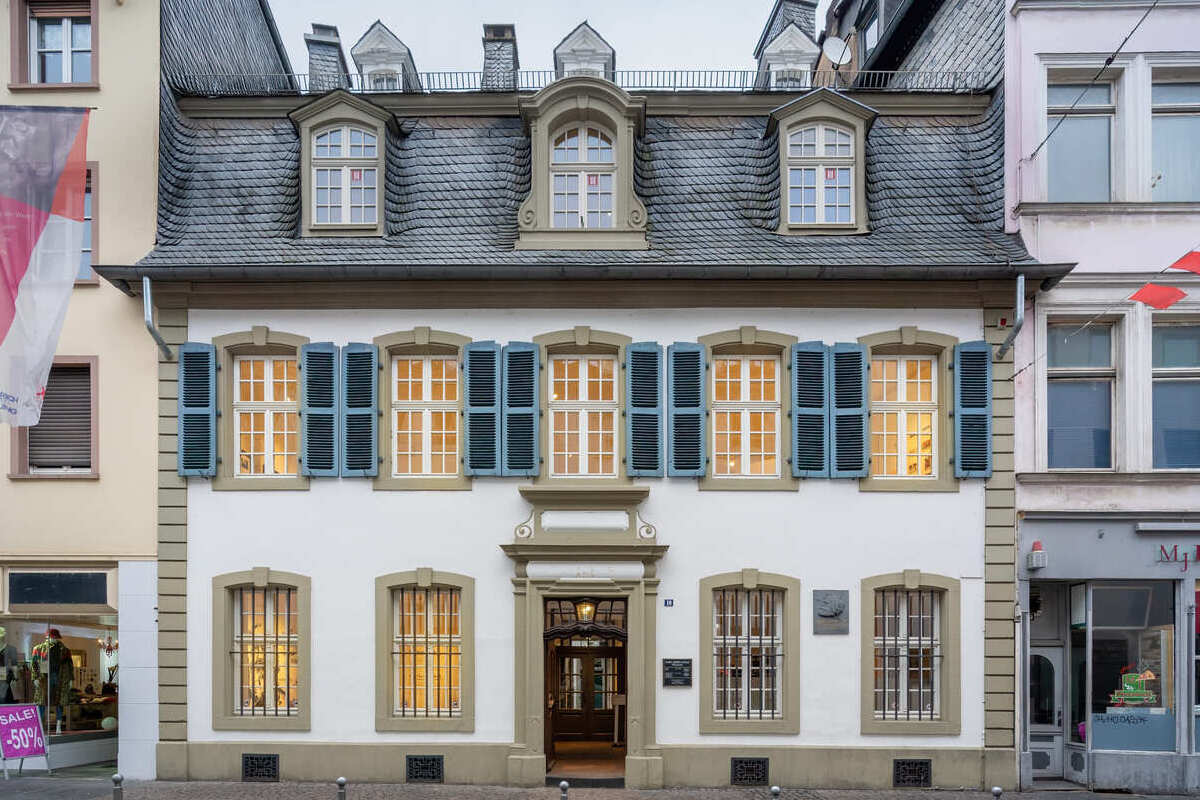
Yep, my proletarian comrade: the father of Marxism, and one of the most consequential and controversial thinkers to have gone down in the annals of history, first saw daylight right here in Trier.
More specifically, at Brückenstraße 10.
That Baroque townhouse is now the Museum Karl-Marx-Haus, and while the workers of the world haven’t quite united yet and we’re not all living rent-free in some post-capitalist utopia, you’ll still have to fork out €7, or around $8, to enter.
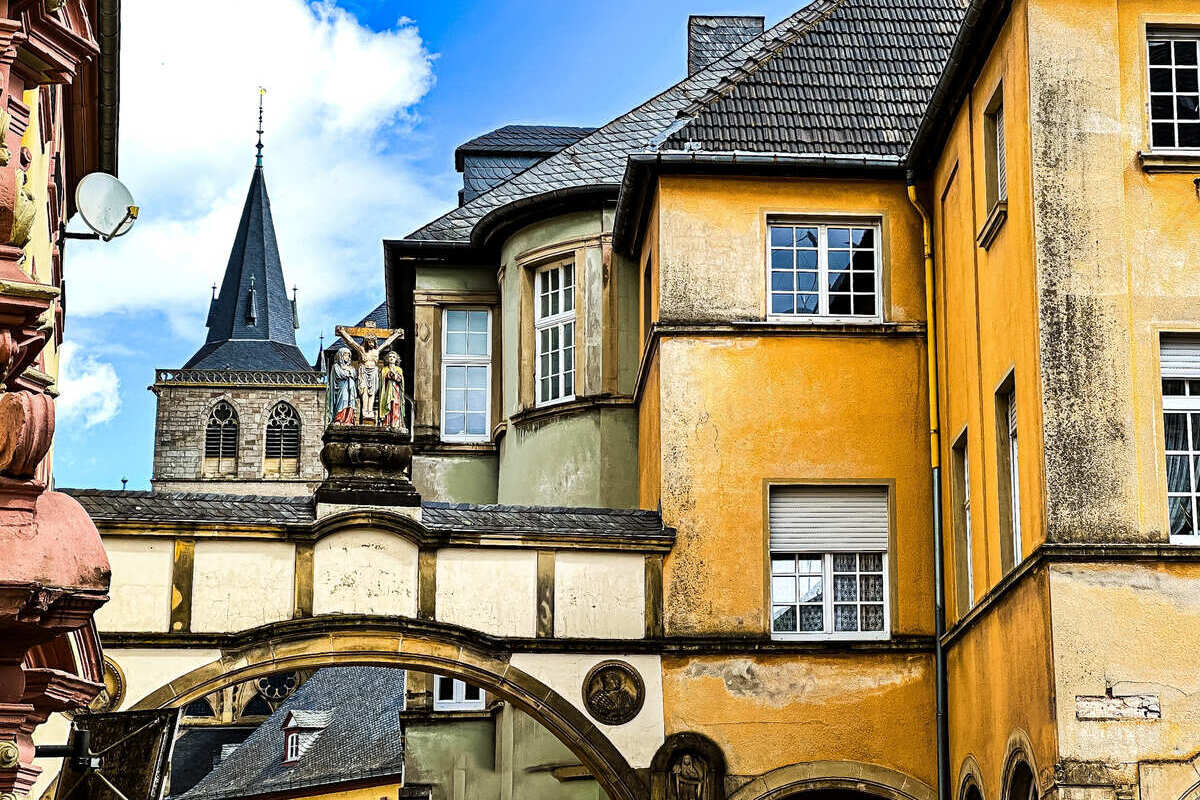
Your average German city serves up some variation of the usual combo of biergartens, reconstructed medieval façades, shopping streets, and rows upon rows of kebab joints clustered around a slightly chaotic Hauptbahnhof district.
Trier has its fair share of those, don’t get us wrong, but it feels like a proper step down in intensity from Munich’s overcrowded, over-commercialized center.
Plus, it has actual Roman ruins.
Europe’s New Entry Rules
Going to Europe in the near future?
Don’t leave your paperwork homework until the last minute: check if you’re up to speed with the continent’s new border and travel regulations.

Americans visiting for a short stay are now required to register biometric data, including fingerprints and a facial image, when entering through an external border into the Schengen Area, a passport-free travel zone comprising 29 European countries.
Germany’s one of those.
The Entry/Exit System has been fully operational since April 10, 2026, and digitally records arrivals and departures, replacing the old passport-stamping process.
This is designed in part to ensure tourists comply with the Schengen Area’s rules: as an American visitor, you can normally remain in the multi-country territory for only 90 days out of any rolling 180-day period.
Head over to the Entry Requirement Checker, type in your destination, and check what entry rules apply as a U.S. passport holder.
Enter your email address to subscribe to Travel Off Path’s latest travel news, straight to your inbox
